
You have the product and you are confident in its quality. How confident are you in the quality of your Ads? Having a high-quality product is half the work but the work you put into your Ad determines how high you rank in Google search Ads or be noticed on Facebook and Instargram enough to lead towards conversions.
You most definitely start with Ad copies that sells. With Google you need to move onto right bidding strategy to win in the auction to rank high in Google search results.
Google Ads talks to your customers through your Ad copies via a special interpreter named “keywords”. This allows a two-sided dialog to take place between Google Ad and your customer. A monologue is often ignored but a good two-way dialogue allows for best understanding that is heard or seen and for obtaining the placement in Google search results.
Google ranks your Ad based on the amount of CPC you bid for and the quality score of your Ad. Therefore, the bid amount alone is not responsible for the rank placement because someone bidding lower amount than you can rank higher than you based on the quality score Google assigns to your Ad and website experience. To work on quality score, you need to work on Ad relevancy which is to ensure that proper keywords are used in your Ad copy (headlines and text) which also matches the content on your website. Your website must also contain those keywords to ensure high Ad relevancy. Quality score is also determined by the overall website experience and how optimized your website is for speed and user experience.

When running and managing your Google Ads campaign, we ensure that we continuously monitor the performance of your Ad copies and keywords and modify your CPC bid amounts based on keyword search and data we get from your Ad campaign. This can include removing negative keywords, changing bids for low or high performing locations or audience segments.

We have been hearing that Meta Ads is no more about targeting but about creatives post Andromeda update. It is all about diversifying your Ad creatives that helps you reach your campaign goals.
Meta’s algorithm is good at handling the targeting now and therefore, it is no longer necessary for us to limit our audience as Meta’s algorithm will automatically find those interested in our product based on our Ad creatives and how we prepare and word it whether these are image or video Ads.
Based on our campaign goal whether it is to drive sales/ leads or to increase awareness, traffic or engagement, Meta’s algorithm will find the right audience. If our campaign objective is sales, then Meta’s algorithm will find the high intent audience to show our Ads to who are more likely to convert. However, we advice to start with interest-based targeting if your Ad account is new and there is no previous data in Meta’s pixel and transition to broad targeting to allow Meta to target the audience. Gradually with enough data, we move towards retargeting and Ad testing.
Since Meta has taken the wheel, that truly means that the technical aspect of your work is incomplete without inner creativity that will drive innovation in the right direction. To be creative and real, it requires that your company understands your audience persona and who will be more likely to convert. There could be more than one type of user personas for same product you sell.
A workout planner for an athlete who does it as part of his work and to compete will sell with a different pitch from when it is being sold to an ordinary man who works 9 to 5 and works out for health purposes. The same product will have two different Ad creatives to target two different types of audiences. To show the right type of Ad creative to the right audience is the work of Meta’s algorithm. What is essential on your part is to ensure that there is a diversification of Ad creatives that speaks to your customers on a personalized level.
However, optimizing your Ad campaigns to ensure there is best Ad creatives in it that outperforms others, it needs testing and doing testing when you have a small budget can be a real hassle. If you allow Meta to optimize your budget at the whole campaign level across all your Ad sets or Ad creatives, then it will first divide the budget equally among all Ad creatives and then later shift almost 80% of your budget towards the winning Ad creatives that can drive conversions. This is a very good short-term approach if you are looking for conversions or sales quickly and allow Meta to take the wheel for you. However, it is not all that good if you are wanting to test different Ad creatives for their long-term potential or slightly different versions of same Ads as Meta will simply ignore different versions of same Ads to avoid Ad fatigue when it is optimizing the budget at its discretion. There are times when you wish to take the wheel from Meta’s hands into yours to ensure you are testing for high performing Ad creatives and to find out what is working for you.
If it’s a new Ad account, you also do not wish to add more Ad creatives too frequently as any disturbance in your campaign will put the Meta’s algorithm back into learning phase and therefore, you must wait for enough conversion to be generated before you start adding more creatives. Usually, a wait time of 7 to 10 days is needed before you enough conversions.

Are AI enhancements good for your Ads?
By all means, use AI based creative enhancements for your benefit but do not abandon discernment and proper judgment. If you have an Ad creative with testimonials on it then you do not want Meta to change or mess around the text on your creative. If you have a text heavy Ad image, then it makes no sense to add Text overlay using AI enhancements. The randomly added AI music on the Ad might not sound the best. However, enhancing CTA with AI suggestions might add value to your Ad. It all depends on your Ad and what enhancement fits it and what should be avoided. Choose wisely to get the max benefit.
AI does not replace your creativity or thinking mind. It only assists it as a good collaborator at times. Always use your discernment and check everything.
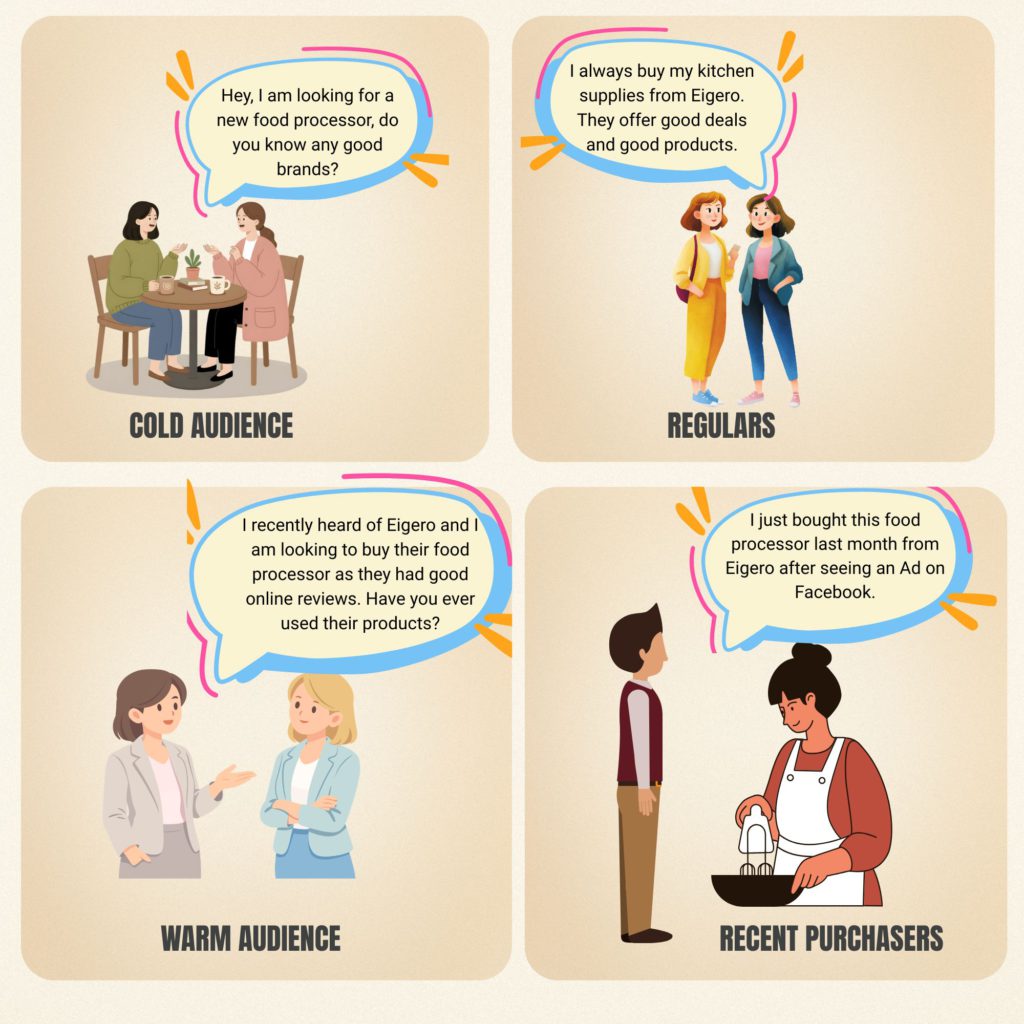
You should create custom audiences in both Google and Meta Ad campaigns for retargeting purpose. You do not want Meta to take credit for your regular customers who already know your brand and very often buy from you. You also do not want to disturb or bombard those customers with repeated ads of your product who just recently purchased your product. When retargeting or running awareness campaigns, you must exclude these audiences so Meta can find newer clients for you and retarget only those who are not your regular customers or recent purchasers.
Retargeting your already established regular customers might increase your ROAS on Facebook but reduce your overall ROI. If you are already reaching out to your top regular buyers through email marketing, then it is best not to spend extra on Facebook to retarget them.
It is also good to test your audiences and which audience performs better during awareness campaigns but we do not recommend that for sales or leads campaigns.